
The rapid rise of digitalization has profoundly transformed the face of public transport. With the advent of innovative technologies, urban transport systems have become smarter, more efficient, and more accessible. From the integration of contactless payments to mobile applications providing real-time information on schedules and routes, travelers now benefit from an enhanced user experience. Digitalization has also paved the way for shared mobility initiatives and the optimization of networks through the collection and analysis of big data, marking a new era for the public transport sector.
Impact of Digitalization on Public Transport Systems
Digitalization is driving a radical transformation of public transport systems, disrupting traditional paradigms in the sector. The digital transformation is palpable across France, where carpooling is becoming firmly established in everyday life, with players like Blablacar and its urban offshoot, BlablaLines. This evolution is part of a broader approach to connected mobility, which reinvents the interactions between users and public services.
Transport companies, like Uber, which has diversified with Jump, its urban micro-mobility subsidiary, illustrate the market’s responsiveness to the growing demand for more flexible and integrated mobility solutions. The transport sector is adapting, offering new forms of services such as ‘Self Service Keolis’, thus meeting users’ expectations for more autonomous and personalized systems.
Big Data proves to be a fundamental lever in the optimized management of traffic, allowing for more precise anticipation of mobility needs and the prediction of accidents and congestion. Digitalization, by driving the emergence of new business models, reshapes the landscape of public transport, where data becomes as valuable as the service itself.
Regulatory events like the Macron Law have enabled the opening of new bus lines in France, thus stimulating competition and innovation in the field. The Covid-19 pandemic has altered mobility habits, increasing remote work and redefining users’ requirements and expectations for public transport. These factors, combined with digital transformation, sketch the outlines of a new era for urban mobility.
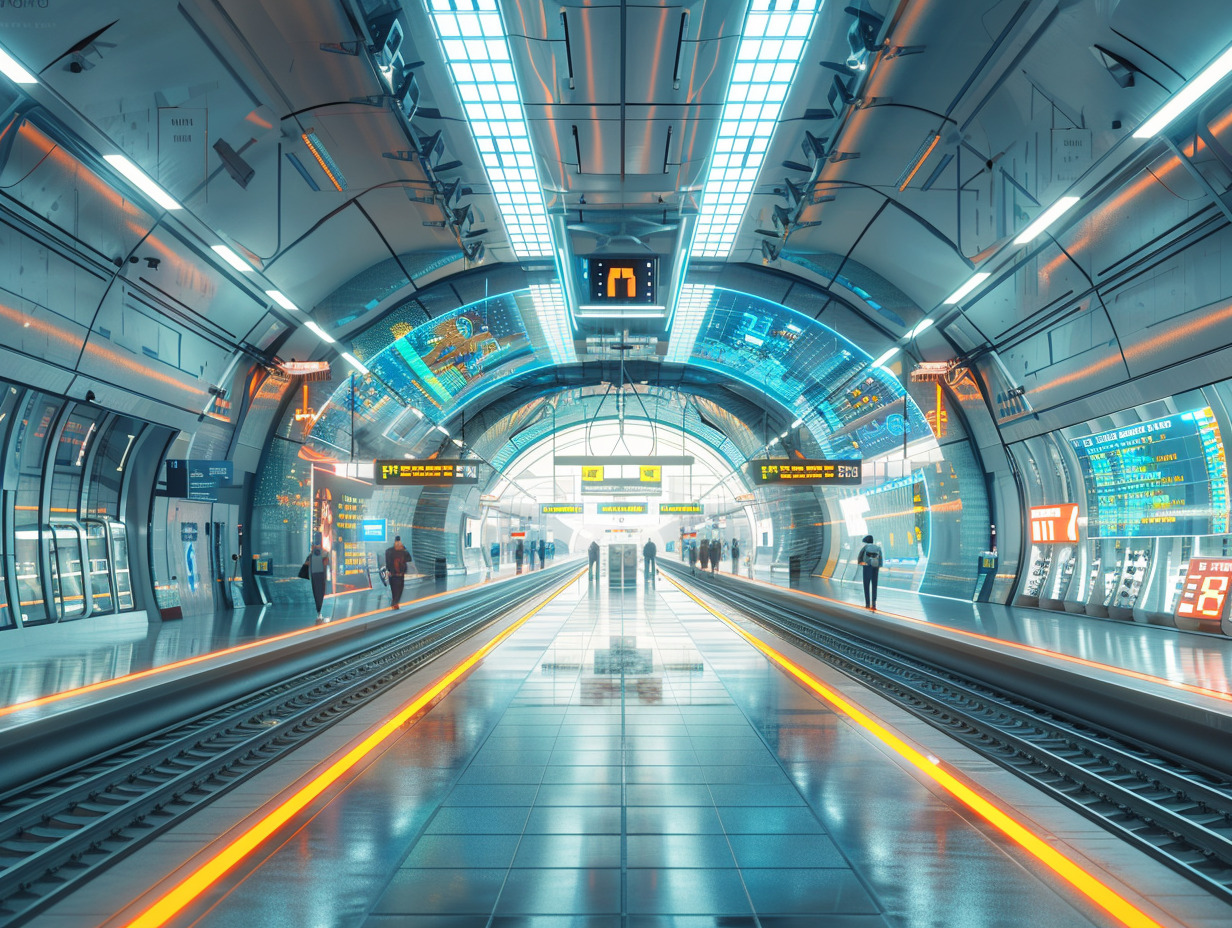
Innovation Strategies and Future Perspectives for Urban Mobility
The 2024 Olympic Games in Paris pose a major challenge for urban mobility and ecological transition. This international event necessitates an acceleration of infrastructure and transport service projects. Strategies are multiplying to modernize existing networks and develop new ones capable of meeting the temporary increase in demand and environmental imperatives.
In this context, the smart city becomes a model to follow. The smart city integrates the use of artificial intelligence to optimize transport flow, reduce polluting emissions, and promote soft mobility modes. Paris, undergoing transformation, is striving to become a benchmark in intelligent and sustainable mobility. The transport management system, powered by artificial intelligence, is set to be a key tool in orchestrating this complex urban symphony.
The energy transition in public transport is another priority area. The shift to electric bus fleets, encouragement of cycling and walking, as well as the improvement of public transport networks form the foundation of this transformation. The challenge is twofold: to reduce carbon footprints while enhancing user experience.
The adoption of intelligent and interconnected transport systems opens promising future perspectives for urban mobility. The convergence of digital technologies and physical infrastructures allows for a more fluid and responsive management of urban movements. Continuous innovation in the transport sector is set to be the cornerstone of a more livable city, where the movement of people and goods occurs with increased efficiency and equity.