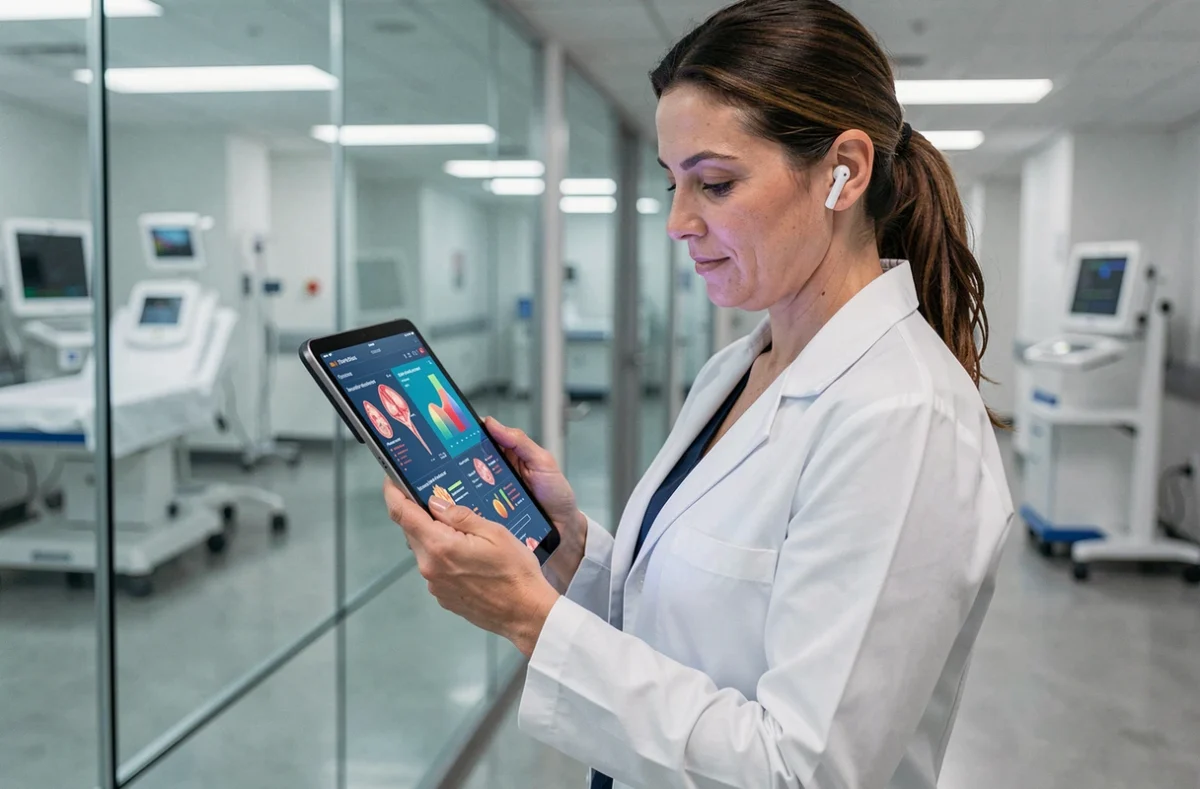
Medical technologies and digital health are evolving along two simultaneous axes: the rise of artificial intelligence algorithms in clinical workflows, and a European regulatory framework that struggles to keep pace with deployments. Understanding these high-tech trends requires distinguishing between what pertains to pure technical innovation and what depends on governance, data interoperability, and the training of healthcare professionals.
European Regulation of Medical AI: A Delayed Timeline
No competitor starts with this topic, and it is a determining angle. The European Regulation 2026/1744, known as the Digital Omnibus on AI, came into effect on July 27, 2026. It postpones the “high-risk” obligations of the AI Act for systems integrated into medical devices and in vitro diagnostic devices until August 2, 2028.
This delay creates a two-year buffer period during which manufacturers must align the requirements of the AI Act with those of the MDR (Medical Device Regulation) and the IVDR. Therefore, medical software publishers integrating AI have a reprieve, but also uncertainty: the classification rules for high-risk systems are still under consultation, such as the one to which MedTech Europe responded in September 2026.
For healthcare professionals and medtech startups, following the news on geekmedical.fr allows them to spot regulatory developments that condition the market launch of these devices.

Health Data Governance: The Real Barrier to AI Deployment
The report published on September 1, 2026, by WHO Europe identifies governance as the main limiting factor for artificial intelligence in health, ahead of the technical performance of algorithms. The cited obstacles are specific: fragmented or biased datasets, uncertainty about legal responsibilities in case of algorithmic error, and a lack of training for caregivers in AI.
WHO recommends measuring progress not by the number of deployed algorithms but by the readiness of governance systems, real-world validation, and patient involvement. This approach changes the lens: a medical innovation is only mature when the institutional framework surrounding it is also mature.
Interoperability and Access to Medical Records
In France, the interoperability of digital medical records remains a structuring project. The legal obligations on e-health actors involve standardized exchange formats and access traceability. Without this technical layer, clinical AI algorithms work on incomplete data, which degrades their reliability.
A high-performing algorithm on fragmented data produces unreliable results. The quality of AI-assisted diagnosis depends as much on the data infrastructure as on the model itself.
Digital Medical Devices and Coverage in France
The year 2026 marks a milestone in the institutional recognition of digital medical devices (DMD) in France. The PECAN nomenclature regulates the coverage of DMDs integrating AI by the Health Insurance. This nomenclature defines the technical and clinical conditions that a medical software must meet to be reimbursed.
Several categories of solutions are concerned:
- Diagnostic imaging support tools that analyze radiological or dermatological images to alert the practitioner to anomalies
- Digital therapies (DTx), applications prescribed by a doctor to treat or support a pathology (sleep disorders, cognitive rehabilitation, chronic pain management)
- Remote monitoring software coupled with connected objects that transmit physiological data in real time to the treating physician
Inclusion in the nomenclature does not guarantee adoption. Caregivers must be trained in the tool, the patient must consent, and the device must demonstrate clinical benefit during evaluations in real-world conditions.

Generative AI in Medical Software: Concrete Uses in 2026
Generative AI has moved beyond the stage of generalist chatbots. In 2026, it integrates into practice management software and hospital information systems in targeted operational forms.
The automated drafting of medical reports from audio recordings of consultations represents the most advanced use. The practitioner dictates or conducts their consultation normally, and the system produces a structured document that complies with medical nomenclatures. The time savings are substantial, but proofreading remains mandatory.
AI Agents and Care Coordination
AI agents represent a distinct evolution from simple text generation. These systems autonomously perform several tasks: prioritizing symptoms, scheduling exams, analyzing biological results. Their deployment raises the question of medical responsibility in case of error in the decision-making chain.
An AI agent recommending a complementary exam operates in a domain that previously relied exclusively on clinical judgment. The boundary between decision support and automated decision-making becomes blurred, and it is precisely this ambiguity that the European regulatory framework seeks to address with the postponement to August 2, 2028.
High-Tech Trends Beyond AI: Connected Devices and Medical Robots
Artificial intelligence captures attention, but other technological innovations are progressing in parallel. Next-generation medical wearables collect physiological data with increased granularity (heart rate variability, oxygen saturation, skin biomarkers) and transmit them directly to clinical monitoring platforms.
Surgical robotics continues to diversify, with robots capable of assisting increasingly precise gestures in specialties such as orthopedics or neurosurgery. These devices do not replace the surgeon: they enhance the precision of the procedure and reduce variability between operators.
- Wearable sensors transmit data continuously, allowing for longitudinal monitoring that is impossible during one-off consultations
- Surgical robots filter out micro-tremors from the practitioner’s hand and offer augmented visualization of the surgical field
- Medical telemonitoring platforms aggregate data from multiple connected devices to alert the physician in case of parameter drift
The adoption of these technologies depends less on their technical sophistication than on their integration into existing care pathways and the ability of institutions to train their teams. The WHO Europe report from September 2026 emphasizes this point: technological maturity without appropriate governance does not produce sustainable clinical benefit.