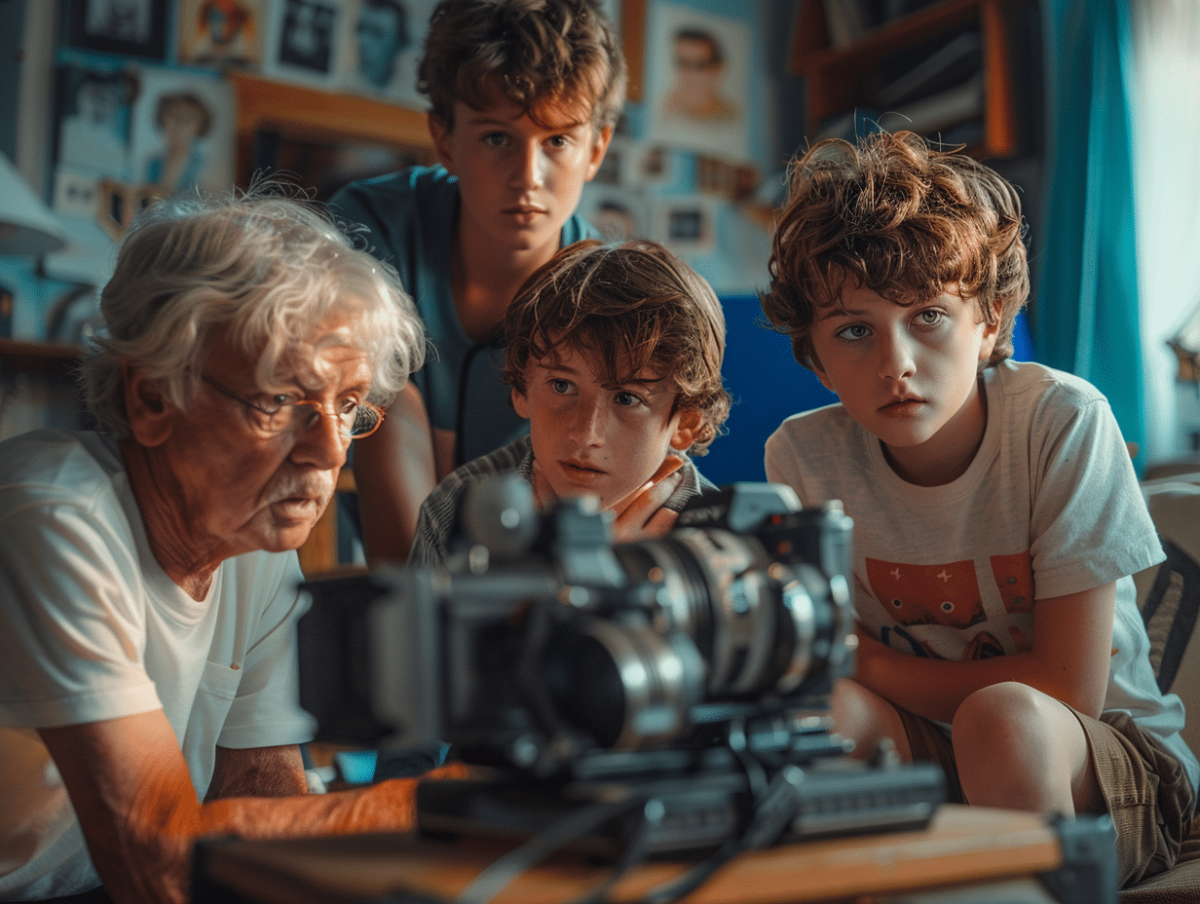
The cinematic legacy passed down from one generation to another is a fascinating aspect of the film industry. When members of the same family invest in the cinematic arts, they often weave a tapestry of cultural and technical influence that endures. Dynasties such as the Coppolas, the Hustons, or the Barrymores have marked the evolution of the seventh art, laying the groundwork for future generations. These families illustrate how talents, techniques, and artistic visions are cultivated and evolve, influencing the style, storytelling, and production of contemporary works, and how family roots can shape the modern cinematic landscape.
Family Legacy in Cinema: Between Tradition and Innovation
Consider the influence of filmmaker families as a multidimensional phenomenon, where tradition and innovation intertwine. The film dynasties, carrying with them a wealth of experiences and practices, have often been the guardians of an inherited cinematic art while being the vectors of radical changes. French cinema, rich in its history, bears witness to this passing of the torch where each generation renews the cinematic language by appropriating and reinventing the work of the previous one.
In this vast tapestry, the master of commercial political film, Bernardo Bertolucci, a contemporary of Elio Petri, author of ‘La classe ouvrière va au paradis’, stands out for his ability to weave powerful, socially engaged, and aesthetically innovative narratives. The cinematic complicity between these two giants extends beyond family ties, revealing a brotherhood of spirit and a convergence of vision that has profoundly marked the industry.
In the wake of figures such as Bertolucci and Petri, filmmakers like Clara Pésery are emerging. Carrying a vision that is both rooted in heritage and resolutely forward-looking, Pésery perfectly illustrates the synergy between respect for origins and the quest for renewed cinematic expression. She embodies this new generation capable of fully embracing the lessons of the past while daring to explore unknown territories.
Thus, family transmission in the field of cinema is far from being limited to a simple reproduction of previous works. It manifests as a constant reinterpretation, where each filmmaker’s contribution enriches and diversifies the cinematic landscape. The history of cinema is thus written in a dialogue between generations, a perpetual exchange where innovation continually draws from tradition to reinvent itself.

Cinematic Dynasties and Their Influence on the Contemporary Cinematic Landscape
The contemporary cinematic landscape cannot be grasped in its entirety without a deep look at the cinematic dynasties that have shaped it. Tracing back to the origins of cinematic art, from Thomas Edison to the Lumière brothers, the evolution of the seventh art is inseparable from the lineages that have managed to alter, generation after generation, the political and aesthetic scope of cinema. Within this vast enterprise, figures such as Ramon Ramos, a militant student in Madrid, and Vangelis Kargoudis, a Greek socialist, have seized cinema as a vector for change, promoting an alternative aesthetic in contexts often marked by war and political repression.
In this context, universities and artistic film clubs have played a fundamental role in disseminating an engaged cinephile culture and training filmmakers in political aesthetics, opposing the reactionary regimes of their time. The example of Thodoros Angelopoulos, a graduate of IDHEC and influenced by film historian Antoine de Baecque, illustrates how these institutions contributed to the emergence of a new wave of directors capable of reinterpreting history through a non-chronological filmic prism. The publication of Glauber Rocha’s works in film journals highlights the impact of cinematic discourses on the perception of social and political issues.
The transmission of these values and knowledge within cinematic dynasties has allowed filmmakers of the caliber of Constantin Costa-Gavras to achieve international fame through their political films. Shlomo Sand’s analysis of Costa-Gavras’s works and Wilhelm Reich’s theories on sexuality and fascist violence prove to be determining influences in the conception of films that do not merely entertain but seek to awaken consciousness. Southern European cinephiles share this conviction of cinema as a means of change, testifying to the profound impact of cinematic dynasties on cinematic politics and the culture of an entire era.