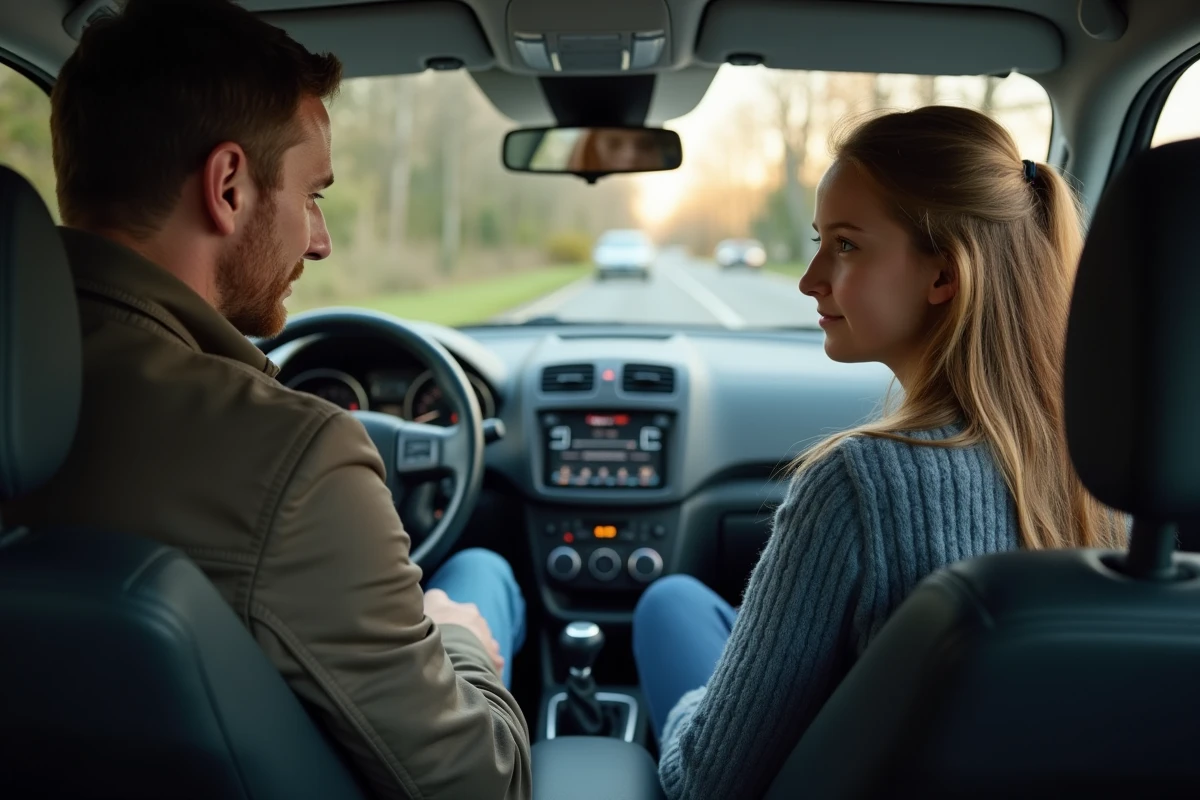
A learner driver can start supervised driving as soon as they obtain their code, without waiting for the end of their driving school package. Contrary to popular belief, there is no maximum age set to access this system, while most candidates think it is only for young people.
In 2024, price differences between driving schools can reach up to 800 euros, depending on the region and the chosen package. The financing options, support conditions, and administrative obligations vary significantly from one establishment to another, complicating comparisons for future drivers.
Supervised driving in 2024: definition, target audience, and differences with accompanied driving
Forget the stereotype: supervised driving is not reserved for newly of-age young people or those just out of high school. This system is open to everyone, with no age limit, provided that they have completed the initial training at a driving school. It is a gateway for both adults in career transition and candidates who wish to gain mileage and regain confidence after a failure.
The real difference with early learning to drive, known as “accompanied driving,” lies in the profile and the time frame. From the age of 15, accompanied driving provides access to a real reduction in the probationary period if the license is obtained on the first attempt. With supervised driving, anyone can apply, but the full probationary period applies, whether you are 25 or 45 years old.
Transitioning to supervised driving first requires the agreement of the driving school instructor, an initial training certificate, and the completion of the mandatory 20 hours of driving. This flexible framework is increasingly appealing to adults, students, or employees who do not want to be stuck on a waiting list or see their budget skyrocket. To closely compare what this entails, the rates on Autoscope provide clarity among the price differences and options chosen in each driving school.
What are the requirements and how does supervised driving work?
To access supervised driving, certain prerequisites must be met. The process starts with validating the highway code, followed by a minimum of 20 hours of driving at a driving school, after which the instructor issues a certificate of initial training. Next comes the tripartite meeting: the student, instructor, and accompanying person meet to clarify roles and expectations.
The accompanying person must have held their license for at least five years without interruption and must not have committed any serious infractions. Road safety ensures that this choice is not left to chance. Another mandatory step is to check with the insurance that the family vehicle’s policy adequately covers supervised driving. A lack of specific extension could be costly, even in the event of a minor accident.
Conditions for supervised driving training
Before getting behind the wheel, it’s better to know what supervised driving entails on a daily basis:
- The accompanying person is designated in advance and joins for each driving session outside of the driving school: the follow-up occurs on varied routes, adapted to the student’s pace.
- There are no minimum or maximum duration limits, nor any mandatory number of kilometers. Progress is adjusted according to personal needs.
- Unlike accompanied driving, no advantages regarding the probationary period are granted.
The accompanying person observes, advises, and alerts if necessary, but never takes the wheel instead of the student. Occasionally, educational meetings at the driving school are scheduled to assess progress, renew focus on road safety, or correct reflexes. This step-by-step follow-up holds everyone accountable, both on the road and as they approach the practical exam.
Driving license costs for supervised driving: what to expect this year?
Supervised driving is not a leap into the unknown financially, but it requires establishing a plan of attack. In addition to the standard investment for the license, often between 1,300 € and 2,000 €, including the code and initial training, a specific package fee must be added, usually ranging from 200 € to 350 €. This additional cost covers administrative management, preliminary maintenance, and educational follow-up until the exam.
Sometimes, additional driving hours are necessary to refine technique. Expect to pay between 45 € and 55 € per hour depending on the establishment. Insurance also offers a supervised driving coverage extension that ranges from 100 € to 200 € per year. This often-overlooked extra cost adds to the overall price, regardless of the make or engine size of the car.
Before opting for supervised driving, it is advisable to have a clear view of each budget item:
- Administrative and management fees: sometimes included in the basic package, but not always
- Educational meetings scheduled by the driving school, most often included in the package
- Dedicated insurance or specific extension, to be requested from the insurance company as soon as the file is created
This system, although it does not provide a reduced probationary period, becomes a real bridge: it attracts both candidates seeking autonomy and those wishing to take the time to gain experience, away from the rigid framework of instructor-led sessions. One shapes their driving instincts over time, with confidence gradually settling in discreetly in the left side of the seat.
At the end of this stage, when the exam day arrives, those who have opted for supervised driving often come with that extra calm and clarity that experience brings: a true ticket to freedom on the road.